Cannacurio #122: The Land of One Hundred Licenses

Minnesota issued their first adult use license back in June 2025 with much fanfare. They even shared the license image in a press release. Industry watchers have been monitoring new license issuance there because it is a large state poised to issue a substantial number of licenses. To gauge the progress of this newest industry favorite, we wanted to compare it against everybody’s east coast darling, New York.
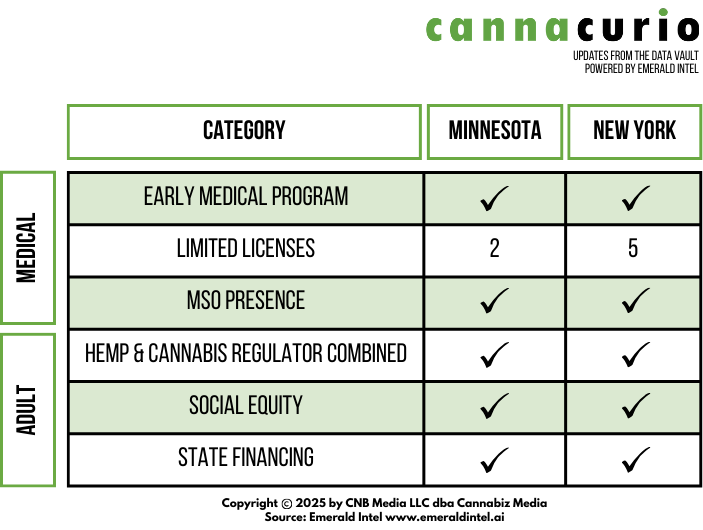
The following table distills the many similarities between these two states:
History
Both states had early medical programs that were characterized by very limited licenses and an MSO presence. Minnesota approved a measure in 2014 that was signed by the governor. The program was up and running by July 2015 and required that only two manufacturers be licensed: Leafline Labs and Minnesota Medical Solutions were selected. Adult Use was finally approved in 2023 with licenses being issued in 2025. An interesting footnote is that two MMN employees drove 5.6 kilograms of distillate from Minnesota to their New York affiliate to help that subsidiary meet a production quota. A whistleblower turned them in.
New York’s program also had an early start in 2015 and started with five “Registered Organizations”: Bloomfield Industries, ColumbiaCare NY, Empire State Health Solutions, Etain and PharmaCann. Empire was owned by Minnesota MedicalSolutions. 5 more organizations were added in 2017. New York legalized adult use in 2021 and the first licenses were issued in November 2022.
Comparisons
In looking at the first 7 months of each program, New York got off to a faster start than Minnesota did and issued 300 to Minnesota’s 124. The first batch of New York’s licenses were for hemp cultivators who were permissioned to grow cannabis to ensure supply. These “conditional” licenses were followed by conditional manufacturer and retail licenses later in the year.
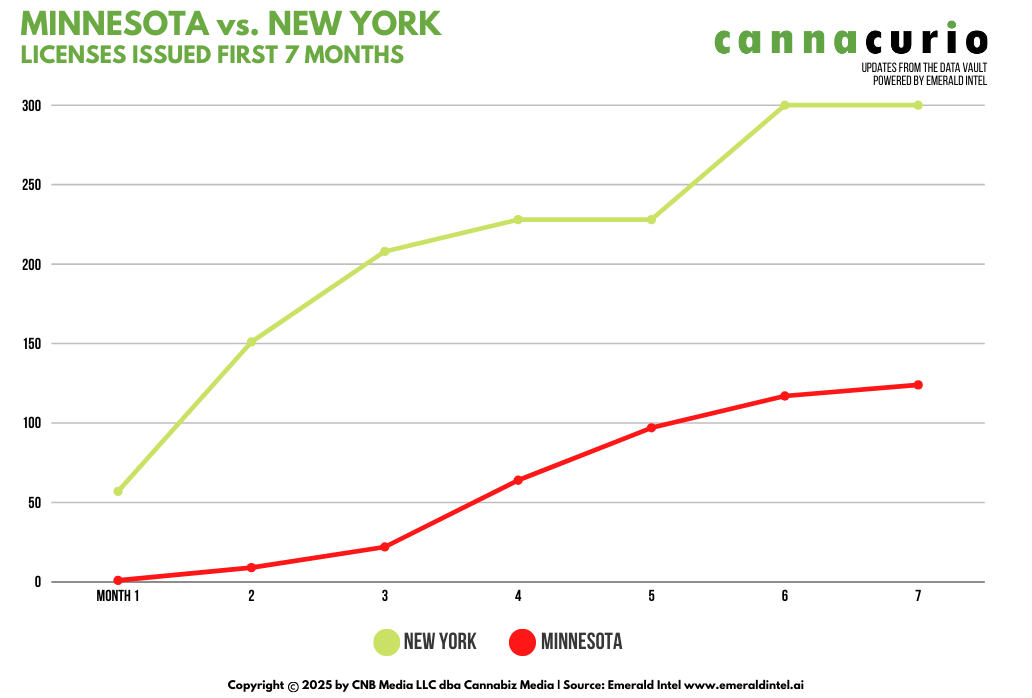
Minnesota’s issuance relied heavily on microbusiness licenses that allowed operators to engage in many activities. These accounted for almost 70% of issued licenses in those first seven months with Medical conversions tallying 15%.
Minnesota and New York have structured their cannabis regulatory frameworks around several shared policy pillars, most notably a commitment to social equity. In both states, regulators embedded equity objectives directly into market design to expand participation by individuals and communities disproportionately impacted by prior cannabis enforcement. Each state uses defined eligibility criteria, application preferences, and technical assistance to reduce barriers to entry and to promote a more diverse licensee base across cultivation, processing, and retail activities.
Both states have also coupled these equity goals with active state involvement in market financing and a unified approach to regulation. NewYork established a state-backed social equity investment fund to finance the buildout of licensed adult-use dispensaries, while Minnesota created state-administered loan and grant programs to support qualified cannabis businesses with startup and operating capital. In parallel, both states placed oversight of adult-use cannabis, medical cannabis, and hemp-derived products within a single cannabis regulatory authority, enabling consistent standards for licensing, testing, product safety, and enforcement across both THC cannabis and federally compliant hemp markets.
Author
Ed Keating is a co-founder of Cannabiz Media, where he led data research and government relations initiatives that power the company’s insights into the cannabis economy. With a career rooted in compliance-focused information services, Ed has overseen product, marketing, and sales for multijurisdictional platforms spanning securities, corporate law, UCC, safety, environmental, and human resources markets. He currently serves as Head of Analytics at Emerald Intel.
Ed spearheads efforts to engage with regulators worldwide, gathering and analyzing corporate, financial, and licensing data to map the evolving cannabis landscape. He is the author of the Cannacurio blog and host of the Cannacurio podcast, where he explores market trends, regulatory developments, and the stories behind the data. A frequent speaker at industry conferences, Ed brings clarity and context to complex cannabis market dynamics. He holds a degree fromHamilton College and earned his MBA from the Kellogg School of Management atNorthwestern University.
Emerald Intel customers can stay up-to-date on these and other new licenses through our newsletters, alerts, and report modules. Subscribe to our newsletter to receive these weekly reports delivered to your inbox. Or you can schedule a demo for more information on how to access the Emerald Intel products yourself to dive further into this data.
Cannacuriois an episodic column from Cannabiz Media, powered by Emerald Intel, featuring insights from the most comprehensive license data platform. Catch up on Cannacurio posts and podcasts for the latest updates and intel.

.png)